
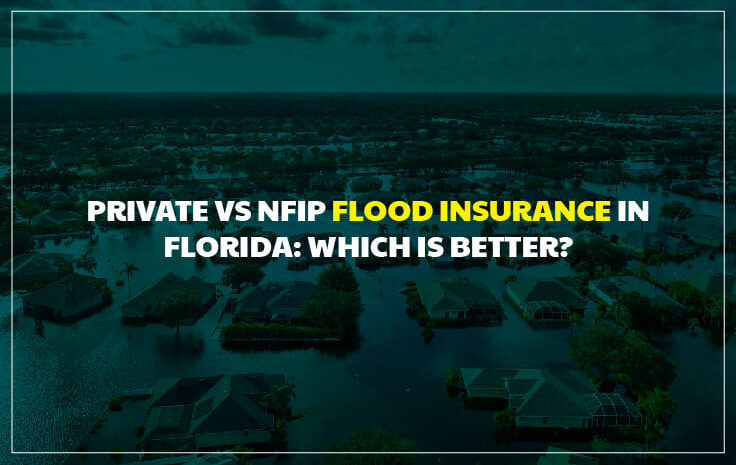
Private vs NFIP Flood Insurance in Florida: Which Is Better?
For most of its history, the National Flood Insurance Program was essentially the only game in town for homeowners who needed flood coverage. That has changed considerably over the past decade. Private flood insurance has grown into a real, competitive alternative in Florida, and in many cases it offers better terms than the federal program. For Florida homeowners trying to decide between the two, understanding how they actually compare is more useful than a one-size-fits-all recommendation.
How the NFIP Works
The National Flood Insurance Program is administered by FEMA and was created in the 1960s in response to private insurers largely exiting the flood market after a series of catastrophic floods. Policies under the NFIP are standardized. The federal government sets the rates, the coverage terms, and the limits. Individual insurance companies sell and service these policies as Write Your Own carriers, but the actual risk sits with the federal program.
For residential properties, the NFIP covers up to $250,000 for the building structure and up to $100,000 for personal contents. For commercial properties, those limits are higher. One feature of the NFIP that often frustrates homeowners is the standard 30-day waiting period before coverage takes effect, with limited exceptions for new home purchases with mortgage requirements.
How Private Flood Insurance Works
Private flood insurance is written by insurance companies using their own underwriting models and policy forms rather than the federal program. The private market in Florida has expanded significantly, partly driven by state regulatory changes that have made it easier for carriers to enter and compete.
Because private carriers are not bound by NFIP rate structures, they can sometimes offer substantially lower premiums, particularly for homes in lower to moderate risk zones. They can also offer coverage features that the NFIP does not, such as higher dwelling limits, replacement cost coverage for contents, and shorter or in some cases no waiting periods.
Key Differences Between Private Flood Insurance and the NFIP
Coverage Limits
The NFIP has hard caps: $250,000 on the building and $100,000 on contents for residential. For many Florida homeowners, particularly those in higher-value coastal areas, $250,000 may not come close to covering the full replacement cost of their home. Private flood policies frequently offer higher limits, some going up to $500,000 or more on the structure, and contents coverage can also be substantially higher.
Cost
NFIP rates are set nationally and have been transitioning to the Risk Rating 2.0 methodology, which aims to price policies based on individual property risk rather than broad flood zone categories. For some Florida properties, this has meant significant rate increases over the past few years. Private insurers use their own models, and for lower-risk properties in particular, private rates can be considerably lower than what the NFIP charges. For very high-risk properties, the comparison may flip.
Waiting Period
The NFIP requires a 30-day waiting period for new policies, with exceptions for policies required by a lender at closing. Many private insurers offer much shorter waiting periods, some as short as 10 to 14 days. For homeowners who realize they lack coverage during a period of elevated storm risk, this can matter.
Contents Coverage
NFIP contents coverage is paid on an actual cash value basis by default, meaning depreciation is applied to the settlement. Private policies often offer replacement cost coverage for contents, which pays the actual cost of replacing items rather than their depreciated value. For homeowners with newer furniture, electronics, or appliances, this can result in a meaningfully larger settlement after a flood.
Additional Living Expenses
Standard NFIP policies do not include loss of use or additional living expense coverage, meaning if flooding forces you out of your home during repairs, the NFIP will not pay for temporary housing. Some private policies include this feature, which is a significant gap to fill given how long flood-related repairs can take.
Claims Experience
The NFIP claims process has historically been lengthy and bureaucratic. Private insurers vary considerably in their claims handling, so this is worth researching before purchasing. Looking at carrier ratings and policyholder reviews provides some indication of how claims are handled in practice.
Can You Use Private Flood Insurance to Satisfy Mortgage Requirements
Yes, as long as the private policy meets the lender’s coverage standards. Federal mortgage lenders are permitted to accept private flood insurance policies that provide at least as much coverage as an NFIP policy. In Florida, state law has also been updated to support broader acceptance of private flood policies by lenders. If you are considering switching from the NFIP to a private policy and you have a mortgage, confirm with your lender before making the change.
When the NFIP Might Still Be the Better Choice
For properties in very high-risk flood zones, particularly those with multiple prior flood claims, private carriers may not be willing to write coverage or may charge more than the NFIP. The NFIP is required by law to cover any eligible property in a participating community, regardless of how many claims it has had. If a property has a complex flood history, the NFIP may be the only viable option.
Additionally, for homeowners who qualify for NFIP grandfathered rates based on older, pre-FIRM construction, those rates may still be favorable compared to the private market. An agent who understands both programs can help you evaluate which side of that comparison you fall on.
How to Choose Between the Two
The best approach is to get quotes from both and compare them on the specific factors that matter most for your property: the coverage limit relative to your home’s replacement cost, the contents coverage basis, the waiting period, and whether additional living expenses are included. Price is important but it is not the only factor.
Best Choice Insurance can compare NFIP and private flood options side by side for your Florida property. Visit flood insurance or call (305) 418-0873 to get a comparison.
Conclusion
The flood insurance landscape in Florida has genuinely changed. Private flood insurance is no longer a niche product, and for many Florida homeowners it offers real advantages over the NFIP in terms of coverage, cost, and flexibility. But it is not automatically the right choice for every property. The decision comes down to your specific home, its flood risk, your coverage needs, and how the available quotes actually compare. Taking the time to look at both options properly is worth the effort.