
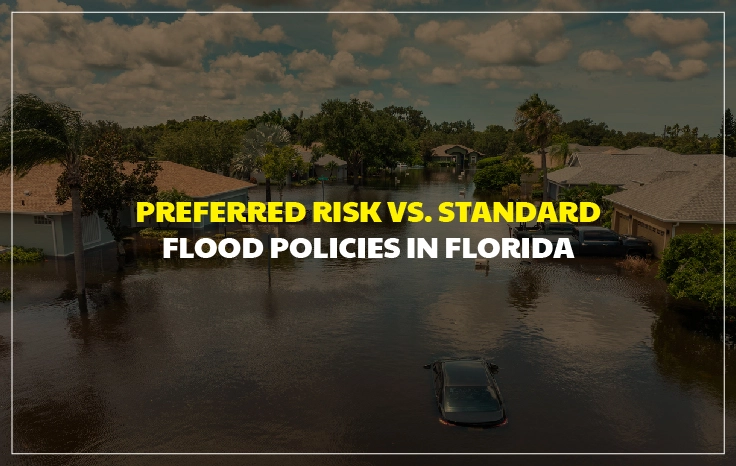
Preferred Risk vs. Standard Flood Policies in Florida: What You Need to Know Before the Next Storm
Florida sits at the center of America’s flood risk map. With over 1,300 miles of coastline, a flat inland terrain that barely rises above sea level in many areas, and a hurricane season that runs six months out of the year, flood damage is not a rare event here. It is a recurring reality that touches neighborhoods from Pensacola to the Florida Keys. Yet one of the most common mistakes Florida homeowners make is assuming their standard homeowners insurance policy covers flood damage. It does not. Flood coverage requires a completely separate policy, and choosing the right type of policy can make a significant difference in what you pay and how well you are protected.
There are two primary flood insurance options available to most Florida homeowners: the Preferred Risk Policy and the Standard Flood Policy. Both are available through the National Flood Insurance Program (NFIP), administered by FEMA, and both can also be mirrored or replaced by private flood insurance alternatives. Understanding the difference between these two policy types is not just a matter of saving money on premiums, though that certainly matters. It is about making sure that when floodwaters rise, you are not left with a claim that falls short of your actual losses.
The confusion between these two policy types is understandable. Insurance terminology can be dense, and most people do not think deeply about their flood coverage until a storm is already bearing down on their ZIP code. At Best Choice Insurance Agency, we work with Florida homeowners every day who are surprised to learn they have been in the wrong policy category for years, sometimes overpaying for coverage they did not need, and other times carrying far less protection than their home actually required.
This guide breaks down the key differences between Preferred Risk and Standard Flood Policies, explains who qualifies for each, walks through Florida Flood Coverage options including private market alternatives, and helps you understand the role of NFIP vs Private Flood insurance in protecting your home. Whether you own a home in a low-risk zone or a high-risk Special Flood Hazard Area (SFHA), what you read here could directly impact your financial security the next time a major storm moves through Florida.
What Is a Preferred Risk Flood Policy?
A Preferred Risk Policy is a lower-cost flood insurance option offered under the NFIP for properties located in moderate-to-low flood risk zones. These zones are typically designated as Zone B, Zone C, or Zone X on FEMA’s Flood Insurance Rate Maps (FIRMs). Properties in these zones have a lower statistical probability of experiencing flooding in any given year, which is why the premiums are substantially lower than those for properties in high-risk zones.
Here is what makes the Preferred Risk Policy appealing for many Florida homeowners:
Lower premiums. Because the risk is statistically lower, the NFIP can offer this policy at a reduced rate. For many homeowners in moderate-to-low risk zones, a Preferred Risk Policy can cost several hundred dollars less per year than a standard policy.
Combined building and contents coverage. Preferred Risk Policies offer pre-packaged options that bundle coverage for both the structure of your home and your personal belongings. This simplifies the decision-making process and ensures you are not accidentally leaving your contents unprotected.
Still provides real protection. Even in low-to-moderate risk zones, flooding happens. In fact, FEMA data shows that roughly 25 percent of all flood insurance claims come from properties outside high-risk flood zones. A Preferred Risk Policy may cost less, but it still provides meaningful financial protection.
To qualify for a Preferred Risk Policy in Florida, your property must meet two basic criteria: it must be located in an eligible flood zone, and it must have an acceptable flood loss history. Properties that have had multiple previous flood claims may be disqualified.
What Is a Standard Flood Policy?
A Standard Flood Policy is the NFIP option for properties in high-risk flood zones, particularly those designated as Zone A, Zone AE, Zone V, or Zone VE. In Florida, a significant portion of the state falls into these high-risk designations, especially in coastal areas, river floodplains, and low-lying inland communities.
If your property is in a Special Flood Hazard Area (SFHA), you are generally required to carry flood insurance if you have a federally backed mortgage. In these situations, a Standard Flood Policy is typically what your lender will require.
Key features of the Standard Flood Policy include:
Higher coverage limits. The NFIP Standard Policy allows up to $250,000 in building coverage and up to $100,000 in contents coverage. For many Florida homeowners, these limits may be insufficient given the state’s rising property values, which is where private flood insurance options become worth exploring.
Actuarially rated premiums. Because high-risk properties carry a greater statistical likelihood of flooding, Standard Policy premiums reflect that elevated risk. Rates are calculated based on your property’s elevation, flood zone, construction type, and other factors.
Required for federally backed mortgages in SFHAs. If your home is in a high-risk zone and carries an FHA, VA, or conventional loan backed by federal agencies, flood insurance is not optional. Your lender will require it, and a Standard Flood Policy is the most straightforward way to meet that requirement.
Florida Flood Coverage: Understanding the NFIP vs Private Flood Options
The Florida Flood Coverage landscape has changed meaningfully over the past decade. While the NFIP remains the dominant provider of flood insurance nationally, private flood insurance has grown significantly in Florida, partly because the NFIP’s Rate Risk 2.0 reforms have raised premiums for many properties.
Here is a comparison of NFIP versus private flood insurance to help you decide which direction makes sense for your situation.
NFIP Flood Insurance
The NFIP is federally backed and available in most Florida communities that participate in the program. It offers standardized coverage with clearly defined terms, which makes it easier to understand what you are getting. However, there are limitations worth knowing:
- Maximum building coverage is capped at $250,000
- Maximum contents coverage is capped at $100,000
- There is typically a 30-day waiting period before coverage takes effect (with some exceptions)
- NFIP policies do not cover loss of use or additional living expenses
- Basement coverage is limited
For homeowners whose property values exceed these caps, or who want more comprehensive coverage including living expenses during displacement, the NFIP may not be sufficient on its own.
Private Flood Insurance
Private flood insurance in Florida has become an increasingly competitive and viable option. Several admitted and surplus lines carriers now offer flood coverage that goes beyond what the NFIP provides. Advantages of private flood options include:
Higher coverage limits. Private carriers can offer coverage well above the NFIP’s $250,000 ceiling, which matters in high-value Florida markets.
Broader coverage options. Many private policies include coverage for additional living expenses, loss of use, and higher contents limits.
Potentially lower premiums. For some properties, private flood insurance can be priced competitively or even below NFIP rates, particularly following the NFIP’s Risk Rating 2.0 changes that increased premiums for many existing policyholders.
Shorter waiting periods. Some private carriers offer coverage that takes effect in as little as 10 to 14 days, compared to the NFIP’s standard 30-day waiting period.
The trade-off is that private flood insurance is not federally backed, and policy terms vary more significantly across carriers. Working with an independent agency like Best Choice Insurance Agency helps ensure you are comparing policies on equal terms and not missing important coverage gaps.
How to Choose Between Preferred Risk and Standard Flood Policies in Florida
The choice between a Preferred Risk and Standard Flood Policy is not always optional. In many cases, your flood zone determines which policy category applies to your property. Here is a practical guide for making sense of your options:
Step 1: Find your flood zone. You can look up your property’s flood zone designation using FEMA’s Flood Map Service Center at msc.fema.gov. Enter your address and review which zone applies to your property.
Step 2: Assess your mortgage requirements. If you have a federally backed mortgage and your property is in a Special Flood Hazard Area, you are required to carry flood insurance. Your lender can confirm what level of coverage they require.
Step 3: Compare NFIP and private options. Even if you qualify for a Preferred Risk Policy through the NFIP, it is worth getting quotes from private carriers to see whether you can get comparable or better coverage at a lower premium. An independent agency can do this comparison for you.
Step 4: Consider your property’s actual value. Florida real estate values have increased substantially in recent years. If your home is worth significantly more than the NFIP’s $250,000 building coverage cap, you may need private flood insurance or an excess flood policy to fully protect your investment.
Step 5: Review your elevation certificate. If you do not have one, getting an elevation certificate from a licensed surveyor can help establish your property’s base flood elevation relative to the surrounding flood zone. This document can directly affect your premium, sometimes significantly.
Flood Insurance and Florida’s Unique Risk Profile
Florida’s geography creates a flood risk profile unlike almost anywhere else in the United States. It is not just about hurricane storm surge, though that is a major factor. Inland flooding from heavy rain, rising rivers, and saturated soil also causes significant property damage across the state every year.
Miami-Dade, Broward, and Palm Beach counties face some of the highest flood risk in the nation due to a combination of low elevations, aging drainage infrastructure, and the effects of sea level rise. But flood risk in Florida extends well beyond South Florida. The Tampa Bay area, the St. Johns River basin, areas around Lake Okeechobee, and low-lying communities throughout Central Florida all face meaningful flood exposure.
This is why Florida Flood Insurance Policy Types matter so much. A homeowner in Hialeah or Miami Gardens faces a very different risk profile than a homeowner in The Villages or Gainesville, and their flood insurance needs should reflect that difference.
FAQs:
Q: Does my homeowners insurance cover flooding in Florida?
A: No. Standard homeowners insurance policies in Florida do not cover flood damage. Flood coverage must be purchased separately through either the NFIP or a private flood insurance carrier.
Q: How do I know if my Florida home qualifies for a Preferred Risk Flood Policy?
A: Your property must be located in a moderate-to-low flood risk zone (typically Zone B, C, or X) and must not have an excessive history of flood claims. You can check your flood zone at FEMA’s Flood Map Service Center.
Q: What is the difference between flood zones A and X in Florida?
A: Zone A and its subsets (AE, AH, AO, etc.) are high-risk Special Flood Hazard Areas where flood insurance is typically required for federally backed mortgages. Zone X (also written as Zone X500 for moderate risk) indicates a lower probability of flooding and is where Preferred Risk Policies are generally available.
Q: How much does flood insurance cost in Florida?
A: Costs vary widely based on your flood zone, property elevation, coverage level, and whether you choose NFIP or private insurance. NFIP premiums in Florida can range from roughly $700 per year for a Preferred Risk Policy in a low-risk zone to several thousand dollars annually for a Standard Policy in a high-risk coastal area.
Q: Can I buy private flood insurance instead of NFIP in Florida?
A: Yes. Florida law allows homeowners to satisfy lender flood insurance requirements with qualifying private flood insurance policies. Private flood insurance can offer higher coverage limits and sometimes broader terms than NFIP policies.
Q: Is there a waiting period for flood insurance in Florida?
A: NFIP policies typically have a 30-day waiting period before coverage takes effect, though there are exceptions (such as when coverage is purchased in connection with a loan closing). Some private carriers offer shorter waiting periods.
Q: What does flood insurance actually cover in Florida?
A: NFIP building coverage typically covers structural damage, electrical and plumbing systems, HVAC equipment, major appliances, and permanently installed carpeting and cabinetry. Contents coverage protects personal belongings including furniture, electronics, and clothing. Coverage for basement items, loss of use, and valuables varies.
Q: Should I get both NFIP and private flood insurance?
A: Some Florida homeowners opt for an NFIP base policy combined with excess flood insurance from a private carrier to close the gap between the NFIP’s $250,000 building limit and their home’s actual replacement cost. An independent insurance agent can help you assess whether this approach makes sense for your situation.
Get the Right Flood Coverage for Your Florida Home
Understanding the difference between a Preferred Risk Policy and a Standard Flood Policy is a meaningful step toward protecting your home. But knowing which policy is right for your specific property, neighbourhood, and financial situation requires a closer look at your individual risk profile.
At Best Choice Insurance Agency, our team works directly with Florida homeowners to review flood zone designations, compare NFIP and private flood options, and find coverage that genuinely fits. Whether your home is in a high-risk coastal zone or a moderate-risk inland neighborhood, we can help you make an informed decision. Reach out to our team today for a flood insurance review and quote.